Virtual Home Staging: A Practical 2026 Guide
Learn when AI virtual staging works, how to prepare room photos, how to assess output quality, and how to disclose edited listing images.
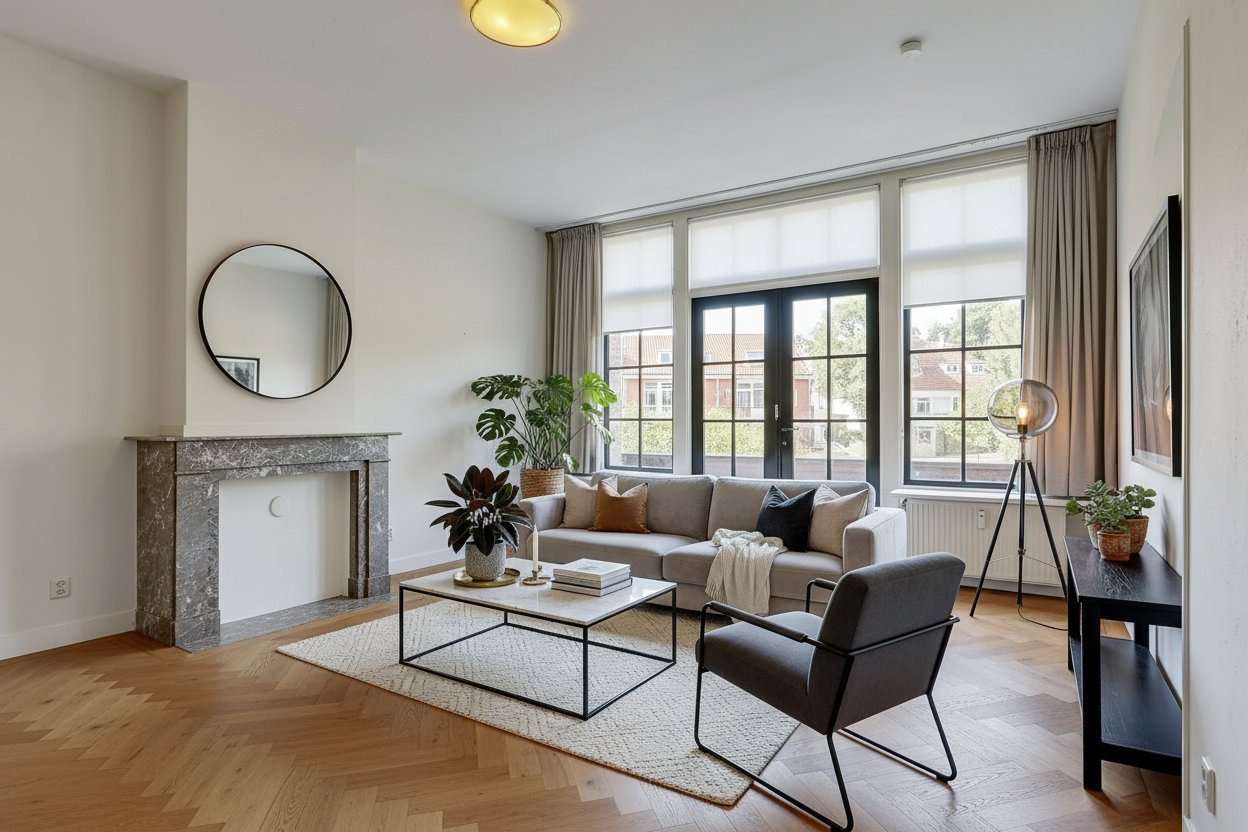
Virtual staging digitally adds or replaces furniture and decor in a property photo. It can help viewers understand how an empty room might function, without renting and moving physical furniture. It is a visual impression, not proof that an item fits or that a renovation is feasible.
When virtual staging is useful
It is a good fit when:
- an empty room is difficult to understand from photographs;
- a dated interior needs a clearly labelled “possible look”;
- a new-build or rental property has no furniture;
- you want to test a few presentation styles before commissioning physical staging.
It should not hide defects, move permanent openings, replace the outdoor view, or depict a structural change as if it already exists. Show the original photo as well whenever practical.
AI staging and manual staging compared
| Factor | Self-service AI | Manual virtual staging |
|---|---|---|
| Turnaround | Often around a minute per attempt | Commonly one or more business days |
| Cost | Usually per image or credit | Usually a higher fee per room |
| Control | Fast variants, less predictable details | More direct control over exact objects |
| Corrections | Regenerate or submit a focused refinement | Designer revision round |
| Best for | Standard rooms and quick concepts | Unusual, luxury, or tightly specified work |
Test any provider with one representative room. Price alone does not predict whether a system will preserve your specific architecture or follow a difficult instruction.
How to photograph a room for staging
- Keep the phone or camera level.
- Use natural light without blowing out the windows.
- Include the whole room; avoid cutting doors or windows in half.
- Remove clutter, cables, paperwork, and personal photographs.
- Avoid extreme phone-wide-angle effects.
- Upload the original file rather than a screenshot or compressed messenger copy.
The model can estimate perspective and scale, but it does not know the measured dimensions. You remain responsible for checking clearances and physical feasibility.
Choose the right edit mode
Use an empty-room staging mode when the architecture and finishes should remain unchanged and only furniture should be added. Use a restyle mode for a broader furniture and decor change. Use a preserve mode for one targeted edit. A renovation visualization can change requested surfaces and fixtures, but should still preserve structural geometry unless you explicitly ask otherwise.
Reference images work best when you state what they represent: “Photo one is the room; photo two is the sofa reference. Put a sofa with that shape and fabric against the left wall.”
How to assess the result
Zoom in and check:
- windows, doors, radiators, sockets, and fixed openings;
- camera position, crop, and aspect ratio;
- believable furniture scale and walking space;
- floor lines, legs, shadows, mirrors, and glass;
- whether the model invented an opening or removed an object;
- whether each explicit instruction is visible.
If one detail is wrong, use a narrow correction: “Keep everything unchanged and rotate only the sofa so it faces the television.” Long lists of competing instructions reduce control.
What virtual staging costs
Redo My Room offers one free watermarked preview. You can unlock that exact result for €1.99. Credit bundles cost €5 for 5, €10 for 15, or €25 for 50 images, with no subscription.
Manual services often charge per room and may charge separately for rush delivery or extra revisions. Compare providers on a result made from your own image, included revisions, output resolution, retention, disclosure tools, and usage rights.
Disclosure and listing rules
Rules vary by country and listing platform and can change. Some portals require an edited image to carry a visible disclosure; a note in the listing description may not be enough. Never use staging to misrepresent permanent property features.
For Dutch Funda listings, an AI-generated or manipulated image must currently be visibly labelled in the image and cannot be the main photo. Redo My Room therefore offers a real-estate export with a visible “AI-GENERATED IMPRESSION” label. Verify the latest rules of every portal you use before publishing.
A defensible listing workflow is:
- use a genuine, unedited main image;
- include the original empty image alongside the staged version;
- place a visible AI disclosure on the edited image;
- do not imply virtual furniture is included in the sale;
- do not alter features a viewer will find different in person.
Privacy and room photographs
Room images can contain faces, family photographs, mail, licence plates, or GPS metadata. Remove unnecessary personal details and upload only images you are allowed to use.
Redo My Room processes source photos to create the result but does not retain them as separate source files in cloud image storage. Locked previews are scheduled for deletion after 7 days and unlocked results after 30 days. See the privacy policy for details.
Common mistakes
Asking for too many changes
A request to change the room function, layout, windows, floor, furniture, and lighting at once gives the model too much freedom. Choose one mode and limit the request to what matters.
Letting style override reality
An industrial style does not require a newly invented brick wall. Style should usually be expressed through furniture, colour, and movable decor unless a renovation is explicitly requested.
Treating a visualization as a guarantee
Virtual staging is not a measured plan, construction drawing, valuation, or shopping list. Verify dimensions and technical feasibility separately.
Create a first preview
Upload one clear room photo, select the closest edit mode, choose a style, and describe one or two important constraints. The first preview is free and does not require a card.
Create a free virtual-staging preview
The best virtual staging makes a room’s potential easy to understand without disguising the real property. Use that standard to judge every output.